
AI websites are here to stay. There is no denying that. Today, there are tools capable of creating designs, writing texts, generating structures, suggesting sections, and building a website in much less time than once seemed possible.
And that is a good thing.
The problem is not artificial intelligence. The problem begins when someone believes that using a new tool means they have already mastered an entire profession.
This is not the first time this has happened. Every time a new technology enters a sector with force, many people think that everything that came before it is going to disappear. But history usually proves something different: the profession does not disappear; improvisation does.
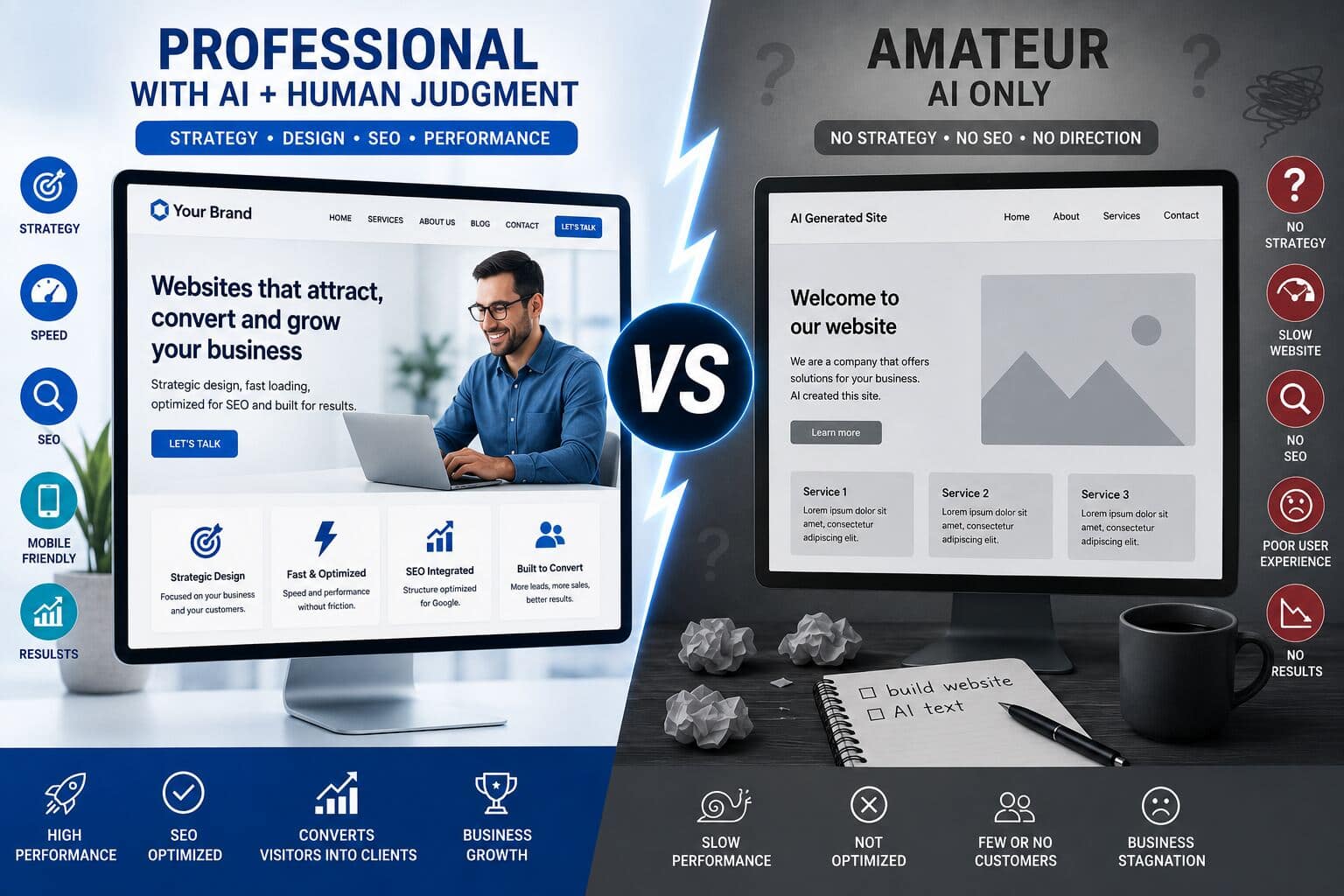
A website made with AI can be useful, fast, and visually attractive. But a professional website needs something more: judgment, strategy, speed, SEO, user experience, and a clear intention behind every decision.
When a new tool seems to threaten everything
Years ago, when I was starting out as a photographer in Cuba, I heard many veteran photographers say that professional photography was dying.
First came those small cameras with flash. Then came the photo development services where anyone could take their pictures, bring in the negatives, and pick up the printed copies. Later, digital cameras appeared, and once again the same fear returned: “Now this is really over.”
It was around 2003, and it seemed as if anyone with a camera could be a photographer.
But reality taught a different lesson.
The camera did not end photography. The camera only made it easier to press the button. The difficult part was still looking, composing, lighting, understanding the scene, and knowing what result you wanted to achieve before taking the photo.
Something very similar is happening with AI websites.
Today, anyone can enter a tool, write an idea, and get a website. But that does not mean the website is well thought out, that it loads quickly, that it has a logical structure, that it is prepared for Google, or that it converts visitors into clients.
The difference was never only in the camera
In photography, having a camera was never enough.
That is why training was necessary. Photographic shooting technique, artistic and commercial photography, laboratory work, composition, lighting, editing, and development. Every part of the process mattered.
A good photo did not turn out well by chance. It turned out well because there was intention behind it.
Over time, that work, which began by taking photos in the neighborhood, grew into a business with 33 workers: photographers, stylists, secretaries, editors, and other professionals who were part of a complete process.
It was not because I had a camera.
It was because I understood the craft.
And that same logic applies today to web design with artificial intelligence. AI can speed up the work a lot, but it does not replace knowledge. It can suggest a structure, but it does not always understand the business. It can write a text, but it does not always connect with the right client. It can generate a page, but it does not guarantee that the page is ready to rank, sell, or grow.
The same thing is happening with AI websites
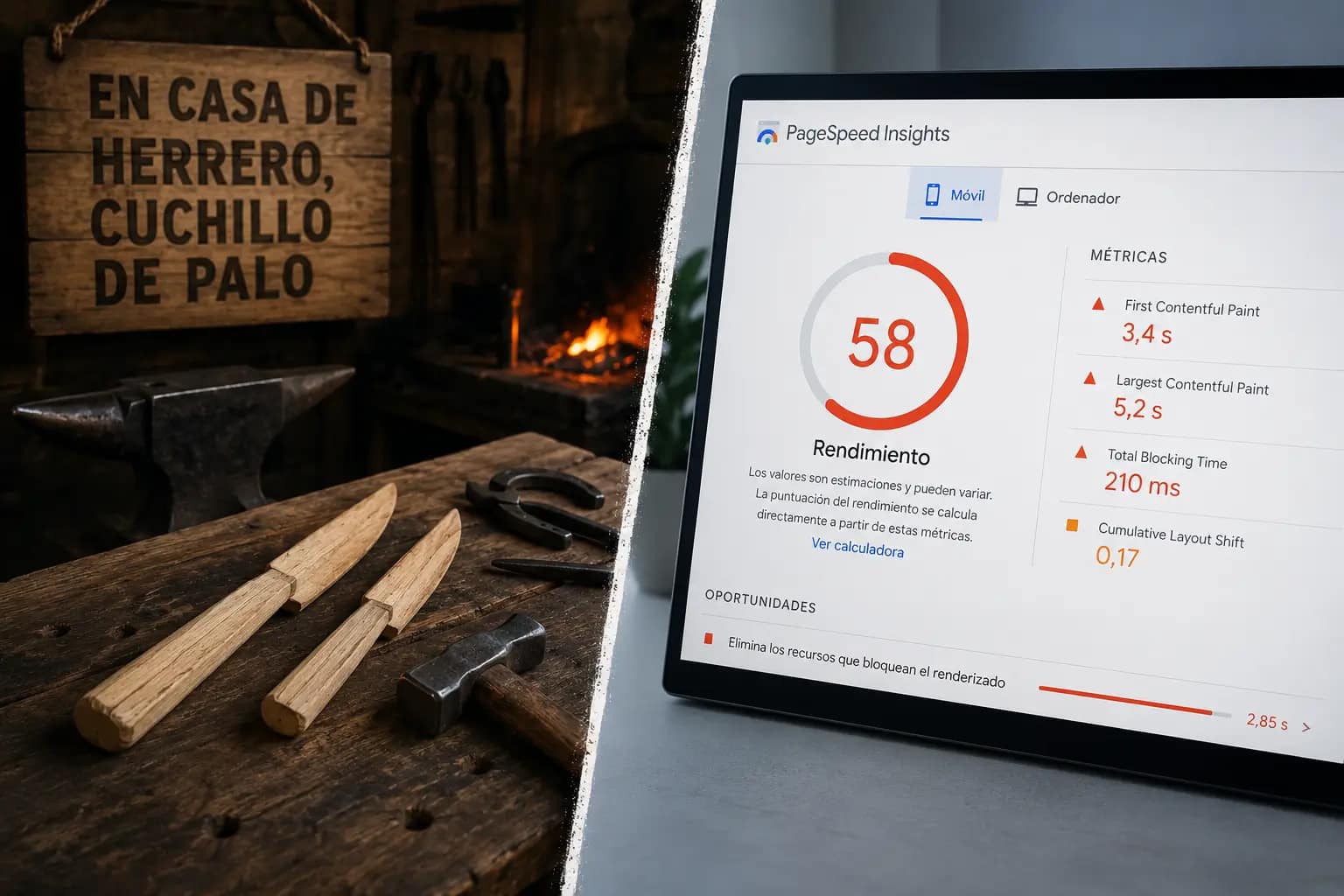
Recently, I met several young people who create websites with AI. While talking with one of them, I asked him how the PageSpeed scores of his websites were.
He did not know what Google PageSpeed was.
And that is the point.
This is not about criticizing those who are just starting out. We all started at some point. Nor is it about rejecting artificial intelligence, because when used well, it is an extraordinary tool.
The problem is selling something as professional when you still do not understand what is happening behind the scenes.
A website is not just a pretty image on a screen. A website is a business tool. It has to load fast, look good on mobile, clearly explain what the company offers, make contact easy, be well structured for Google, and offer a good experience to the person visiting it.
If a website takes too long to load, the user leaves. If the content does not answer what they are looking for, it does not connect. If the structure is confusing, Google has a harder time understanding it. If there is no strategy, the website becomes a business card lost somewhere on the internet.
Creating a website with AI is not the same as creating a professional website
Creating a website with AI can be fast. Creating a professional website with AI requires more.
The difference lies in knowing what to ask the tool, what to accept, what to correct, and what to build from scratch when necessary. AI should not lead the project. It should help execute it better.
A professional website needs a clear architecture. Every page must have a purpose. The homepage cannot be a drawer full of pretty phrases. The services page must explain what you do, who you do it for, and why someone should trust you. The blog must answer real questions. The texts must be written for people, but also organized so Google can understand them.
Design must also support the goal. It is not about adding effects, animations, and modern blocks just for the sake of it. It is about guiding the user. Helping them read, understand, trust, and take action.
A website can look beautiful and still be poorly made.
It can also be simple, fast, clear, and work very well.
PageSpeed, SEO, and performance: what many people do not look at
When we talk about AI websites, people almost always talk about how fast they can be created. But they rarely talk about how fast they load.
And that is not the same thing.
Google PageSpeed Insights allows you to analyze the performance of a page and provides information for both mobile and desktop. It also works with user experience metrics such as Core Web Vitals, which help evaluate aspects like loading, interactivity, and visual stability.
This is not a technical detail without importance. For a business, speed matters. A slow website can lose visits, opportunities, and clients.
That is why, when creating a website with AI, you need to review what code it generates, how images load, what scripts it uses, whether it is optimized for mobile, whether it has a good heading structure, whether the images have alternative text, whether the content responds to search intent, and whether the website is prepared to grow.
SEO does not begin after publishing.
SEO begins with the structure.
It begins when you decide which pages the site needs, which keywords you are going to work on, how the content will be linked, what titles you will use, and how you will help the user find what they are looking for.
AI is powerful, but it needs judgment
Artificial intelligence is not the enemy of web design. On the contrary. When used well, it can save time, organize ideas, speed up processes, and help create better content.
Today, AI tools can be used to prepare drafts, generate outlines, analyze topics, suggest sections, improve texts, create prototypes, and solve tasks that used to take many hours.
But AI should not be an excuse to stop thinking.
One thing is using artificial intelligence with judgment, training, and experience. Another very different thing is depending on it without understanding what it is doing.
When someone understands web design, SEO, and optimization, AI becomes an ally. When they do not, AI can become a machine that produces beautiful but fragile pages.
And a fragile website can fail exactly where it matters most: attracting, explaining, ranking, and converting.
Fast websites prepared to grow naturally
A good website should not be created just to “be on the internet.”
It should be created to grow.
That means thinking about speed, structure, content, SEO, and scalability from the beginning. A website for an entrepreneur or a small business can start simple, but it must be ready to add services, articles, success stories, new pages, forms, automations, or campaigns.
When a website is born disorganized, every future improvement becomes more expensive.
That is why building on a solid foundation is so important.
Today, it is possible to create fast websites prepared to grow naturally using AI, yes. But the key is using it with judgment. Knowing which parts the tool can speed up and which parts require human analysis.
AI can help build the initial structure. But someone must decide whether that structure makes sense for the business.
AI can help with writing. But someone must review whether that text sounds real, whether it connects with the audience, whether it has SEO intent, and whether it inspires trust.
AI can suggest a design. But someone must check whether that design guides the user or simply decorates the screen.
What a well-made AI website should have
A well-made AI website should meet several basic requirements.
First, it must be clear. In just a few seconds, the visitor should understand who you are, what you do, who you do it for, and how they can take the next step.
Second, it must load fast. Images, code, plugins, and external resources must be optimized so the website does not become heavy and slow.
Third, it must be designed for mobile. Many users visit websites from their phones. If the mobile experience fails, the website fails.
Fourth, it must have a clean SEO structure. Well-organized headings, clear URLs, optimized meta descriptions, useful content, and meaningful internal links.
Fifth, it must have good texts. Not inflated texts or generic phrases. Texts that explain, connect, and help the user make a decision.
Sixth, it must measure results. A professional website needs to know what is happening: visits, clicks, forms, most-viewed pages, performance, and opportunities for improvement.
Seventh, it must be able to grow. A website should not be trapped inside a rigid template that later prevents progress.
The phrase by Félix Arencibia applied to web design
A photography teacher, Félix Arencibia, once said something I never forgot:
“What is the difference between a professional photographer and an amateur? The amateur, after taking the photo, says: what a good photo I got. The professional says: it came out the way I wanted.”
That phrase applies perfectly to web design today.
The amateur creates a website and says: “Look how nice it turned out.”
The professional asks something else: does it load fast? Is it easy to understand? Is it prepared for SEO? Does it guide the user? Does it respond to a strategy? Does it help the business? Did it turn out the way it needed to?
That is the difference.
This is not about looking down on anyone who uses AI. It is about understanding that the tool cannot be the only merit of the work.
The real difference is in the judgment.
So, is it worth creating websites with AI?
Yes, it is. But not in just any way.
AI websites can be a great option for entrepreneurs, freelancers, small businesses, and local businesses that need to move forward with agility. They can reduce time, make processes easier, and open up very interesting possibilities.
But a website should not be created only because a tool allows you to make it quickly.
It should be done well.
If you are going to create a website with AI on your own, review more than just the design. Look at the speed. Look at the structure. Look at whether the texts say something useful. Look at whether each page has a purpose. Look at whether the site can grow. Look at whether you are creating a digital presence or just a pretty screen.
And if you decide to work with professionals, look for someone who does not use AI as a trick, but as a tool. Someone who understands design, SEO, performance, content, and strategy.
Because in the end, the difference is not in the camera, nor in the software, nor in artificial intelligence.
The difference is in the craft.

AI helps, but judgment leads
AI websites are not the future. They are part of the present.
But today’s digital world does not need more websites made in a hurry. It needs clearer, faster, more useful, and better thought-out websites.
Artificial intelligence can help a lot on that path. It can accelerate, organize, and enhance. But there is still a need for a professional eye that knows what it wants to achieve and why.
At Ibero Studio, we believe in using technology without losing judgment. Creating fast, well-structured websites prepared to grow naturally does not depend only on a tool. It depends on knowing how to use it with intention.
If you are thinking about creating a website with AI, it is worth doing it calmly, strategically, and with a clear idea: that it should not only look beautiful, but turn out the way it should.