

I recently moved to Murcia, specifically to the district of El Palmar. When you arrive somewhere new with a business project in mind, it is only natural to look around.
You want to get to know the area, understand how the local market works, and discover who has been operating in your industry for years. Not necessarily to copy anyone or start some pointless rivalry, but simply to understand where you stand.
Since I work in web design, WordPress, SEO, and website optimization, I ended up doing what any curious professional would do: visiting the websites of other agencies and studios in the area.
I found companies with years of experience, interesting projects, and professional backgrounds that deserve respect. These are people who, I am sure, know perfectly well how to optimize a website.
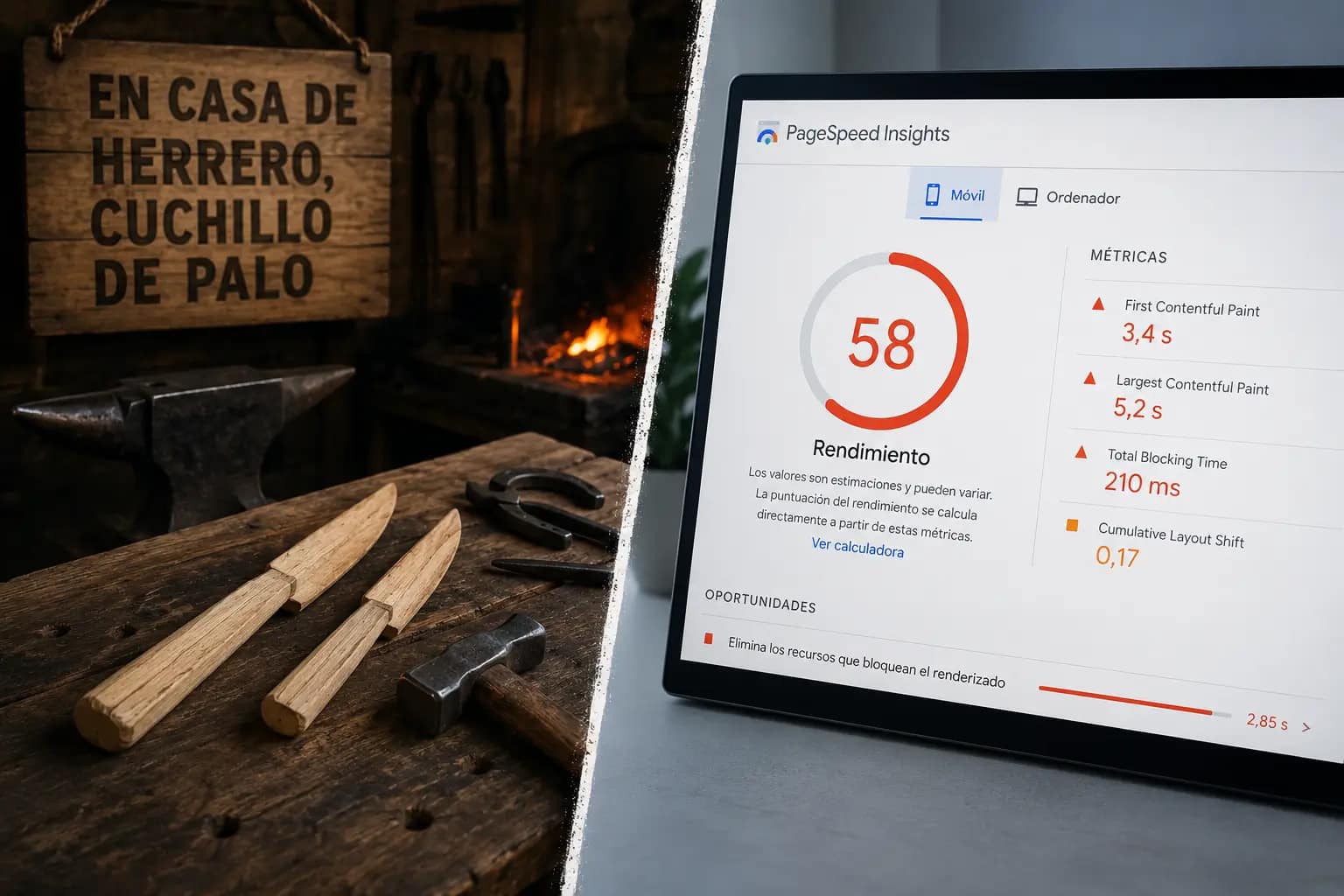
However, I also came across something I did not expect to see quite so often: slow websites that appeared to have been neglected, with performance scores ranging from 56 to 78 on Google PageSpeed Insights.
That immediately brought an old Spanish saying to mind:
The blacksmith’s house has a wooden knife.
It expresses a very similar idea to the English saying:
“The shoemaker’s children go barefoot.”
An Agency’s Website Is Part of Its Work
A plumbing company can have a basic website and still provide excellent installations. A restaurant can have an outdated site and serve extraordinary food. Even a lawyer can do outstanding work while their website looks as though it belongs to another decade.
But when a company sells web design, SEO, maintenance, or optimization services, its own website is judged by a different standard.
It is not merely a business card. It is the company’s storefront, its technical portfolio, and a public demonstration of what it knows how to do.
Before calling, requesting a quote, or sending an email, a potential client is already evaluating the agency. They look at the design, read the content, test the navigation, and wait for the page to load.
All of that happens before a single conversation takes place.
That is why it feels contradictory to find agency websites that talk about speed, user experience, and performance, yet take too long to display their content or jump around when opened on a mobile phone.
That does not mean the people behind them are bad professionals. Nor does it mean that the websites they build for clients suffer from the same problems. But the first impression remains.

Does a Low PageSpeed Score Mean a Website Is a Disaster?
No.
Google PageSpeed is not the ultimate judge of a website. It is a diagnostic tool and, like any tool, it should be interpreted with common sense.
A website can receive an average score and still be useful, attractive, and profitable. In the same way, a site can score close to 100 and still fail to inspire trust, explain its services clearly, or generate a single enquiry.
The score is not everything.
Analytics tools, videos, maps, fonts, chat systems, tracking platforms, and many other features commonly found on modern websites can also affect performance.
The real problem begins when a low score matches a genuinely poor experience: slow loading times, buttons that take too long to respond, images that appear late, or elements that shift while someone is trying to read.
At that point, we are no longer talking about an obsession with achieving a green circle. We are talking about a website that puts obstacles in the visitor’s way.
A Slow Website Does Not Only Annoy Google
Sometimes we talk about optimization as though it were a private matter between a website and a search engine, as if Google were the only party affected by poor performance.
But there is a real person behind every visit.
It could be someone comparing agencies on their phone while sitting in a café. It could be a business owner who needs to rebuild their website. It could be someone with a weak connection, little time, or several browser tabs open.
When a website takes too long to load, that person will not always wait. They close the tab and keep searching.
They do not carry out a technical audit. They do not wonder whether the problem comes from the server, the images, or a JavaScript file. They simply feel that the website does not work properly.
That feeling then becomes associated with the company.
A slow website does not merely lose points in a test. It can also lose opportunities, completed contact forms, and conversations that never had the chance to begin.
I Understand Perfectly Why It Happens
The interesting part is that I can understand how a website reaches that point.
Agencies and digital professionals often spend their entire day solving other people’s problems. There are projects to deliver, last-minute changes, meetings, quotations, maintenance tasks, and clients who need an urgent response.
Meanwhile, their own website gets left for later.
First, an update is postponed. Later, another plugin is added. Then an analytics tool, a tracking pixel, a chat widget, or a new animation is installed. Over time, the website begins to accumulate layers.
It still works, but it becomes heavier and slower.
There are also websites that were designed years ago and have received small cosmetic changes without ever undergoing a complete technical overhaul. They may look current on the surface, but underneath they carry old decisions, unnecessary plugins, and solutions that nobody dares to touch because they “still work.”
It is not always a lack of knowledge. Very often, it is a lack of time.
The problem is that visitors do not know that story. They only see the result.

Installing a Caching Plugin Does Not Always Solve the Problem
When a website is slow, the automatic response is often to install a caching plugin and activate a few settings.
Sometimes it helps. Other times, it only hides the problem.
Properly optimizing a website means reviewing the server, images, fonts, external scripts, theme, plugins, and the way each section has been built.
It also means making decisions.
Does the homepage really need that video? Is it necessary to load five different fonts? Does that visual effect add anything useful? Does it make sense to keep a plugin that performs only one minor function?
The goal is not to remove everything and leave behind an empty website. It is to find the right balance between design, usefulness, and performance.
A website can be beautiful without being heavy. It can have personality without forcing users to wait.
Web Design Does Not End on Launch Day
There is a common idea that a website is finished the moment it goes live.
But a website is a living system.
WordPress changes. Plugins are updated. Browsers modify the way they behave. New images, forms, tracking codes, and sections are added.
A website that worked perfectly three years ago may have become slow even if nobody has made one major change.
That is why maintenance should involve more than simply clicking the update button. It should also include checking how the website loads, how it behaves on mobile devices, and whether it still provides a decent experience.
A website can look well maintained while being technically neglected at the same time.
Looking at the Competition Also Means Looking at Yourself
Reviewing other agencies’ websites should not become an exercise in superiority.
It is easy to spot mistakes from the outside. The difficult part is keeping your own house in order while dealing with the demands of daily work.
What I saw after arriving in Murcia did not make me think that other professionals do not know what they are doing. It reminded me that none of us is immune to falling into the same situation.
Today, you may have a fast, clear, and well-built website. Two years from now, if you have not reviewed it, it may have become something very different.
That is why observing the competition also forces us to ask ourselves some uncomfortable questions.
Does my website truly represent the quality of my work? Does it load as well as it should? Does it explain clearly what I do? Am I taking care of it, or is it simply still online because nothing has broken yet?
These are questions every professional in the industry should ask from time to time.
You Do Not Need a Perfect 100 to Make a Good Impression
I do not believe an agency should become obsessed with achieving a perfect score.
A score of 100 may look impressive in a screenshot, but it does not guarantee that the website is good. A site also needs strong content, personality, clarity, and a proposition that makes sense.
Speed is one part of the overall picture, not the whole picture.
However, when the service you sell is specifically about building and improving websites, you cannot afford to ignore it.
Your website does not need to be perfect. But it should show that you care about the same things you recommend to your clients.
That is the real issue.
Not the exact score. Not the colour of the circle. Not the screenshot you can share on social media.
Consistency.
Has Your Own Website Also Been Left for Later?
Sometimes there is no need to rebuild a website from scratch. It may be enough to identify what is slowing it down, remove what is no longer necessary, and make improvements that help it load faster without losing its design or personality.
If this article has made you wonder whether your own website is also using a “wooden knife,” you can send me the URL. I will review its performance, its mobile experience, and the issues that may be driving potential clients away before they ever contact you.
This is not about chasing a perfect 100 on PageSpeed at any cost. It is about having a faster, more stable website that better reflects the quality of the business it represents.
An agency, a freelancer, or any company can explain its work brilliantly. But before the first conversation begins, its website has already spoken.
And it is worth making sure it does not end up saying, unintentionally:
The blacksmith’s house has a wooden knife.